
[Originally published April 21, 2020 on Deem.com.]
Fifty years.
Think about how much technology has changed over the last 50 years. It’s now the 21st century. It’s the difference between having watched the first moon landing on television to, today, carrying more technology in our pockets than was used by the Apollo 11 computer. And it’s the difference between today’s oldest and youngest workers.
Each of these groups grew up with vastly different resources and technology available to them. The challenges this presents to companies could affect everything from office floor plans to healthcare and benefits packages, and, importantly, how they manage their travel programs. So, Deem worked in collaboration with the Association of Corporate Travel Executives (ACTE) on a survey and report to better understand how travel buyers can help make the travel experience seamless across generations.
Corporate travel technology’s generational differences
Employee health and safety are paramount in the eyes of business leaders and travel managers. Yet, the differences we uncovered between generations are clear: Younger workers, who may play a larger role in introducing meaningful change as their numbers in the workforce continue to grow, are more comfortable with technology. And they’re also, perhaps, more willing to push the boundaries of policies.
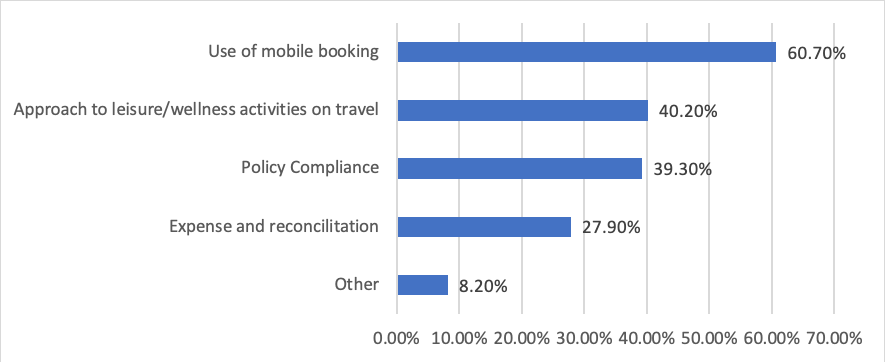
For instance, in Figure 1, below, survey respondents reported that travelers’ behavior and practices varied most by age group in the use of mobile booking (60.70%), their approach to leisure or wellness activities during travel, (40.20%), in policy compliance (39.30%), and expense and reconciliation (27.90%).
Younger Generation Z workers grew up with technology as yet undreamed-of when their Baby Boomer colleagues were entering the workforce. The consumer-friendly, cloud-based platforms some people have now incorporated into their daily lives are an expectation for Gen. Z and many younger Millennials. As such, younger groups tend to have higher rates of adoption when it comes to mobile-friendly digital apps for planning travel, whether for work or leisure.
The flip side, however, is that their tech prowess means they also expect a certain level of efficiency in every application they interact with. If tools they’re given at work don’t live up to their ideal, they’re more inclined to switch over to digital solutions they’re familiar with and ask for forgiveness later. While it may be easier to track our younger, digital-native coworkers because of their reliance on technology (and their nonchalance over privacy concerns,) they may not fully comprehend why using approved tools and staying in compliance are so critical to their health and safety when on a business trip.
Corporate travel amid global health concerns
While business travel is currently suspended over concerns about the COVID-19 virus, health concerns lead us to our next point. That is, 39% of travel buyers said that compliance, or leakage, was a key difference between generations. By keeping employees in compliance with company policy and booking tools, travel managers can better balance their goals for cost savings and other financial issues, with their duty of care responsibilities. But, if the tools provided to especially tech-savvy users don’t meet their standards, they’ll likely turn to shadow IT, or solutions outside of the company’s control, to get the job done.
As shown in the report, noncompliance with approved tools can create real risk for travelers and employers. For instance, business travelers may suddenly find themselves in an area hard-hit by a highly contagious virus that is rapidly shutting down cities, provinces and countries.
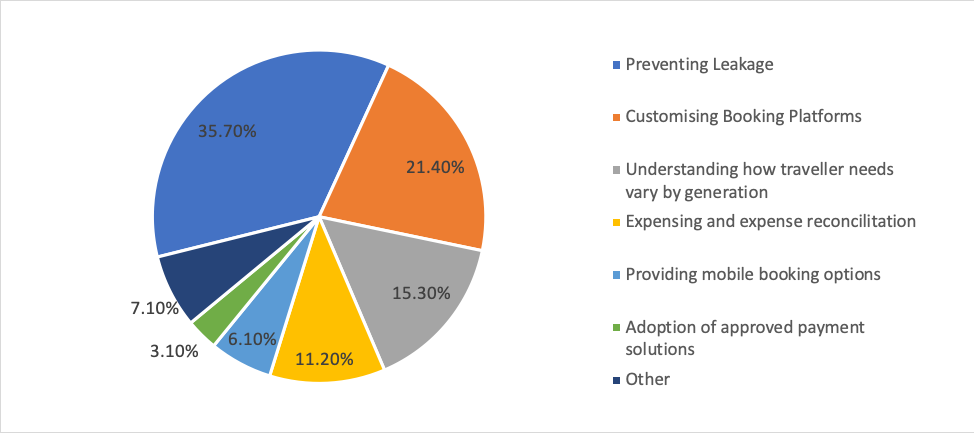
When workers go rogue, they can inadvertently increase risk to their own safety and to the company. Yet, 35.7% of respondents said the most significant challenge they face when managing travel across generations is preventing leakage.
If you aren’t aware of where, when and how your people are traveling, will you be able to alert them about potential dangers in their destination? Will they know how to get help returning home when needed? What happens if someone gets in an auto accident in a foreign country? These are all examples of the kinds of incidents your company may be held liable for, making it imperative for travel managers address non-compliant behavior.
Get ready for the future of corporate travel
Younger generations make up ever more of today’s workforce: Millennials will represent half of workers by the close of 2020 and that figure rises to 75% by 2025. Gen. Z already comprises 24% of today’s workforce. Using the right travel solution – one that is both robust and provides an excellent user experience – is the best way to increase adoption rates and keep all generations of users satisfied.
As we eventually move beyond the COVID-19 crisis, we’ll need to become smarter and more organized in how we pursue new business opportunities. “Now is the time for businesses to think about how they can implement new technology, so they’re ready when the crisis begins to resolve,” said Rizzo. “And make no mistake – we expect our industry will bounce back stronger, smarter and more prepared for any future disruptions that may arise.”
The full report by Deem and ACTE offers even more insights from the study and possible solutions.
Get the report here.
 Diana Brandon, Marcom Writer & Strategist