

[Originally published May 6, 2020 for Deem.com.]
In this highly uncertain time in the travel industry, Michael Jarrard believed we needed the kind of conversation we haven’t been seeing yet. Of the many webinars that are replacing live events, what’s been missing is a webinar that is actually a conversation among the moderator, panel, and the online audience.
As VP of strategic sales at Deem, Michael is interested in how travel managers are handling their roles and helping them navigate this and future crises. On April 28, 2020, Michael was joined by industry guests Claire Langford (CoreTrust), Christine Roesch (Cerberus Capital Management), Charlie Mitchell (GoldSpring Consulting), and Cami Earsley (Ellison Technologies) to discuss pressing questions affecting travel managers right now. Throughout the interactive webinar, viewers were able to both ask questions and participate in online polls and word cloud surveys that kept the conversation engaging and relevant.

In case you missed it, following are the top three takeaways from the conversation.
Travel manager relationships
First, the audience participated in a word cloud survey, listing in 20 characters or fewer the word that best summarizes lessons learned for their travel program from the coronavirus. As seen in the graphic below, the top three responses were “fluid,” “patience,” and “innovative.”

As shown in the image above, after the top responses of “fluid,” “patience,” and “innovative,” other words that were submitted included “confusion,” “communication,” “safety,” “data,” “flexibility,” “uncertainty,” and “change.”
The survey was followed by conversation among the panelists. Whether in building and deepening relationships or taking care of travelers, there’s general agreement that human connections are most important. Things are changing every day and each change brings something new for us to learn.
Changes are affecting everyone from suppliers to buyers throughout the chain. How travel managers view tools such as technology or RFP agreements will also change based on the relationships or partnerships they build. This could also lead to new and different players coming up in the travel space.
Traveler engagement, whether under the headers of duty of care or traveler wellness, was another topic that resonated with the panel. Top of mind for many people is how travel managers can communicate with travelers in ways that really matter. The importance of traveler communication may help accelerate travel personalization, which allows travel managers to approach traveler wellness in different, measurable ways. The entire traveler journey could potentially be impacted from both a positive, traveler wellbeing standpoint and a financial one, as well.
It’s also a good idea to check in with employee travelers, whether to understand if they’re comfortable traveling during a crisis or even just to provide emotional support. Many places are stepping up all-hands meetings led by top executives, bringing together teams for virtual happy hours, or, like Deem recently did, holding virtual “bring your kids to work” day, to keep people engaged. Efforts that include direct video or phone calls helps establish personal connections and demonstrates integrity and dedication to employees, TMCs, and everyone with whom we interact. When travel managers show that they’re confident in our programs, people will feel more confidence when they need to travel or work with us.
One relationship that stands out is partnerships with TMCs. During international crises, a TMC can be an invaluable resource to help travel managers know which employees are overseas and facilitate communication with them.
Corporate travel programs and policies
What should travel teams focus on during an international crisis? The answer came down to three points: policy, fluidity, and communication. Most companies have travel policies, but very likely they aren’t updated every week or every day. Corporations need to pay particular attention to how much of a country is actually open during a pandemic.
There’s a patchwork of rules between states and countries that can be difficult to stay knowledgeable about when there are almost daily changes. Focusing on what’s most relevant in your top markets and to your top travelers, and remaining open to making changes for things like hotel closures, if needed, will provide a game plan to follow during a crisis.
The future of corporate negotiated rate programs is also unclear. Hotels, specifically, may need to revise their approach to RFPs when negotiations start up again. Many companies cannot meet the room nights they had in their 2020 contracts. And there may be some different requirements in RFPs, that is, what people are asking for in their requirements, thanks to large room block cancellations, for example.
“It does come back to the value of the partnership,” Michael said. “I think it’s incumbent on us to have those challenging conversations – that we know the situation that everybody finds themselves in is not necessarily ideal. There is a need for open dialog.”
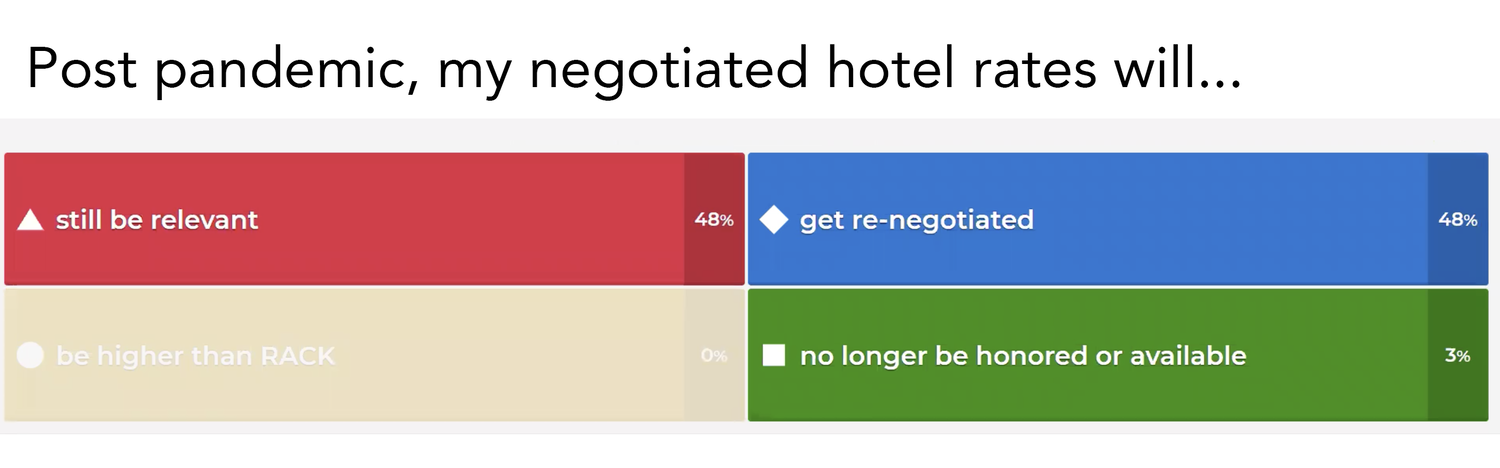
As shown in the image above, in an online poll held during the webinar, 48% of respondents said they think their post-pandemic negotiated hotel rates will still be relevant and 48% said they believe they’ll be re-negotiated. Just 3% said they thought the negotiated rates would no longer be honored and none said they thought rates would be higher than RACK.
Travel program technology
There’s a wide range of ideas where technology to advance travel programs is concerned. A fairly even distribution of ideas was supplied in our online poll, as seen in the resulting word cloud image below, including travel portals, unused ticket tracking, duty of care, and traveler trackers.

What technologies did the panelists think will be most important to advancing travel programs? GPS has its pros and cons. It does provide a way to know exactly where travelers are at any given time. This knowledge would enable companies to be sure of employees’ locations and contact them if there was an immediate need. And most people are familiar with using GPS simply from using their own cell phones, which could lead to an uptick in adoption rates. Some program managers believe that being able to know where travelers are and get them home quickly should be the highest priority, above cost considerations and pricing in the management program.
Detracting from the benefits of GPS, however, is the invasive nature of that information. It has a “Big Brother” feel to it, and both travelers and companies may feel it’s a difficult question to wrestle with. Some business travelers consider GPS an invasion of privacy and companies won’t approve it at all. This creates an opportunity for travel managers to build up their duty of care and risk management programs to include vendors who offer some type of tracking.
Many travel managers also say they need reliable data, whether it’s hotel attachment or tracking travelers who don’t go through the system. And starting to trend is a question of how guest and recruitment travel will be handled. Relying on technology that provides relevant data to help travel managers locate and communicate with travelers is one way they believe their roles will change in the future.
Our next interactive webinar, Engage: Reclaiming Travel, is planned for May 28, 2020. Register here to be part of the conversation.
 Diana Brandon, Marcom Writer & Strategist